Views on 9/11
I was born after 9/11. There is a story, maybe I made it up, that my parents where visiting my grandparents to tell them of the pregnancy when the second plane hit.
I don't remember how old I was when I first learned about 9/11, and I don’t remember when I realized just how significant that event was. But I do remember thinking in March 2020 that COVID would be our 9/11.
Interestingly, we've collectively repressed our memory of the pandemic, and although (at least here in Germany) memories of the September 11 terrorist attacks are fading, nothing has taken their place. The prominent status that 9/11 holds is, of course, striking; one would probably have to write something here about cultural imperialism and grievability, but I'm interested in images.
For example, I've been a bit obsessed with Thomas Hoepker’s "View from Williamsburg, Brooklyn, on Manhattan, 9/11" for a while now.
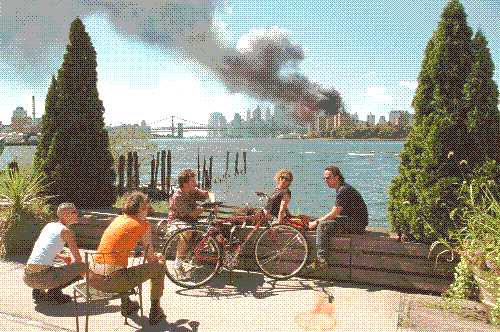
The colors immediately catch your eye. The orange of the woman’s top on the chair, the red bicycle, the green trees, the blue of the sky, and the gray smoke rising from the World Trade Center. But also the hairstyles that still look like they’re from the 90s, the sunglasses, the tramp stamp. Only when you look very closely at the picture it becomes clear that no one there is as relaxed as the image initially tries to convey.
The difference between the image and everything else associated with 9/11 – the "image-event gap" is enormous. Perhaps this is because one immediately understands this image as an observation of an observation. The conversation of this group in the foreground is placed in context with the background by the image, but it is not clear what (if anything at all) is being discussed regarding the background. It is precisely the possibility that the group could also be talking about something else, that the coupling to the world-historical event is only loose, the contingency in the relationship between everyday life and the state of emergency, that make this image so provocative.
It is of course a somewhat iconoclastic gesture to adopt a different perspective on a world-historical event just to pit it against the events outstanding status, but I would like this to be understood as a gesture "against the freezing of images", as an iconophilic gesture in Latour’s sense:
The only way to achieve truth, objectivity, and sanctity is […] to move quickly from one image to the next, rather than dreaming the impossible dream of being able to leap to a nonexistent original. (Latour, Iconoclash)
And the "truth" is that everyday life and a state of emergency, normality and catastrophe, always occur simultaneously. Perhaps the problem with writing and speaking about catastrophes is that they are almost always described as massive turning points marking a before and after, even though they do not seem all that significant at the time. It is only in hindsight that the wound tears open. The only way to get an honest picture of an event is to shift it out of focus, to decenter it.
(I made an are.na channel to collect some "views on 9/11")